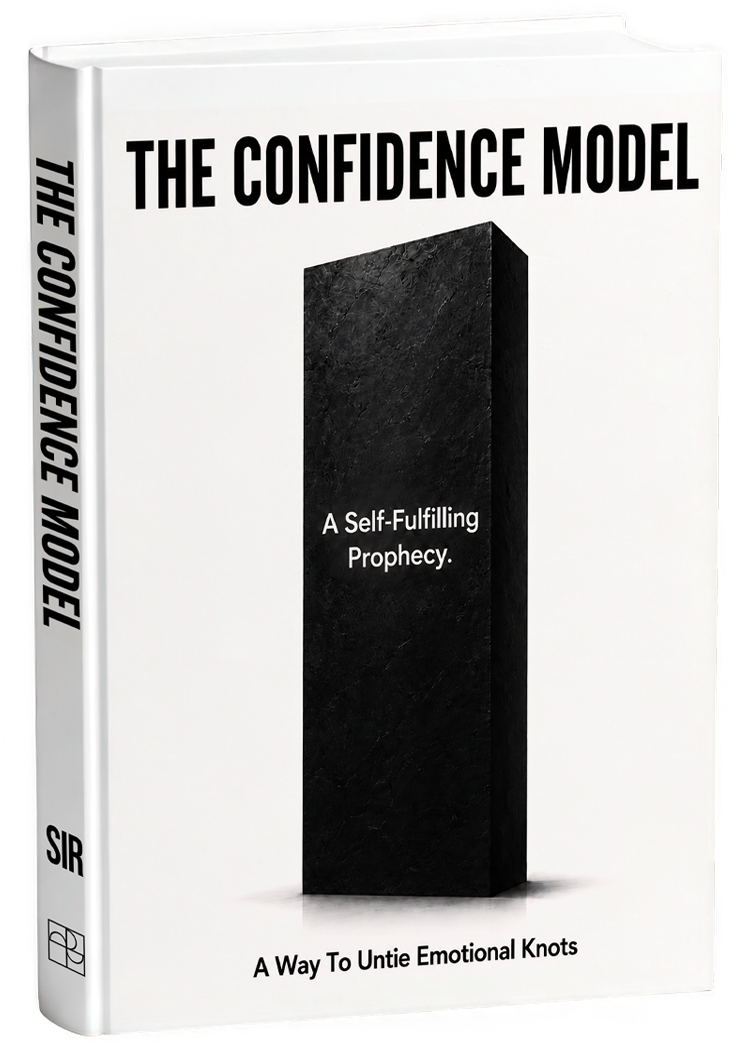
• out now

    The Confidence Model

    A Self-Fulfilling Prophecy.

    by Scott Iain Robertson

    The Confidence Model is a memoir, a personal inquiry, and a practical model for understanding confidence, fear, doubt, action and meaning.

    Written from lived experience rather than theory alone, the book follows one man’s attempt to make sense of family, fighting, failure, fatherhood, marriage, pressure, humour, regret and change. What begins as a search for confidence becomes something more honest: an examination of whether confidence is always required at all.

    At the centre of the book is a simple question: Is this required?

    That question is applied not only to fear, uncertainty and negative emotion, but also to confidence itself. The result is a model that does not ask the reader to pretend, perform or become someone else. Instead, it invites them to examine what they are carrying, what they have inherited, what they have chosen, and what may no longer be needed.

    The book does not present confidence as a magic state or fixed destination. It suggests that confidence may be the sound the engine makes when the internal parts are working together.

    Part memoir, part reflection, and part open challenge, The Confidence Model asks the reader to consider how meaning is formed, how belief becomes action, and how a person might move forward without needing absolute certainty first.

    It is not a promise that life becomes easy. It is an invitation to ask what is required, what is true, and what meaning you would like to create from what remains.


When I look back on childhood, I do not see a search for meaning or a life of exceptional hardship. I see a child living his life: trying things, getting things wrong, falling off bikes, standing up to bullies, making mistakes and asking questions. The difficulties were real because they were mine, but they were also the ordinary difficulties of one family doing its best with the tools it had.

Excerpt from THE CONFIDENCE MODEL

Coaching taught me that I had a voice. It also taught me that not everybody was interested in hearing it. I had a habit of putting people's noses out of joint. Some of that came from being direct. Some came from the confidence of having tested myself. Some probably came from the part of me that believed a useful answer should be welcomed simply because it was useful to me. People don't work that way.

Excerpt from THE CONFIDENCE MODEL

I went looking for confidence because I thought confidence was required. The search gave me language, diagrams and questions. It gave me a way to examine belief, action and result. Then it turned towards its own foundation and asked whether the original requirement was true.

Excerpt from THE CONFIDENCE MODEL